

32 Absolutely Beautiful Origami Kusudamas

Kusudamas are modular origami models where multiple units are fit together to form a ball-like shape. The word “kusudama” literally means “Medicine Ball” when translated from Japanese. They were originally used for incense and potpourri, which I guess is where the name comes from.
If you’re an origami purist, then you make kusudamas without any sort of glue, tape, or string to hold the units together. A lot of kusudama designs are made in such a way that all the pieces will fit together strongly and you won’t even need glue. However, if you’re making a kusudama to display and you want to use a bit of tape or glue to make sure it doesn’t fall apart, we won’t judge you.
You often see kusudamas hanging from a string, and a lot of them have fancy tassels hanging from the bottom as well. Because kusudamas are made from multiple units, you can use different colored paper for some absolutely beautiful results and patterns.
Caliope, Designed and Folded by Ekaterina Lukasheva
Our first kusudama for this post is by Ekaterina Lukasheva, who is definitely one of the top kusudama designers out there. It’s folded using some of Peter Keller’s excellent paper. There’s no glue, tape, or anything like that here.

Instructions not available.
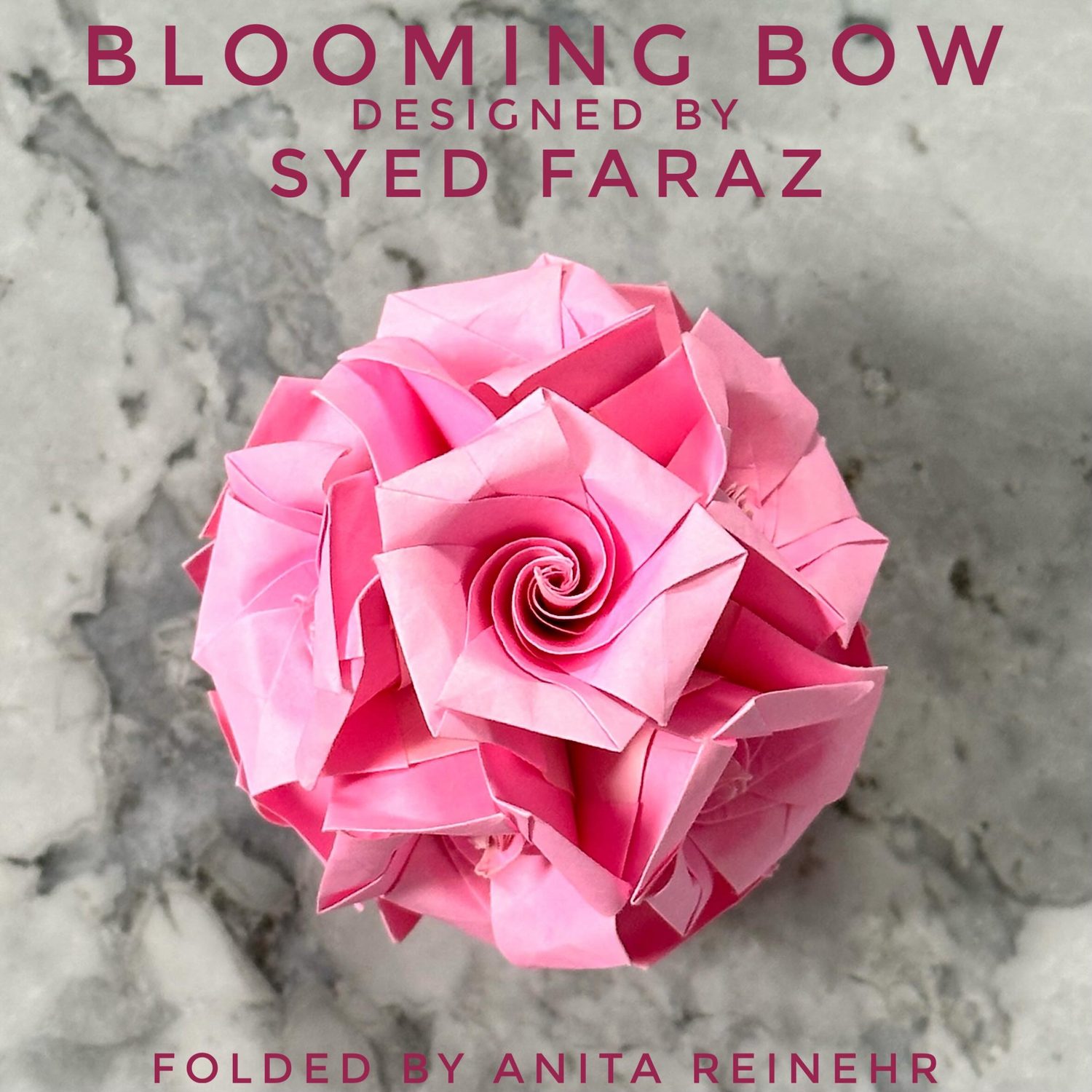
Blooming Bow, Designed by Syed Faraz and Folded by Anita Reinehr
Here’s a beautifully blooming pink kusudama with a rose-like swirl at the center of each unit. It’s folded from 30 sheets of 3.75 x 7.5 cm kami paper, with no glue or tape needed.
Instructions not available.
Sierpinski Triangles, Designed and Folded by Andrey Ermakov
This is a very unique kusudama design because you don’t normally see this much detail on the faces of the shapes. It’s folded from 24 separate units, and the designs are fantastic.

Instructions not available.
Designed and Folded by Maria Sinayskaya
Here’s an absolutely gorgeous kusudama. The colors of the paper you use have a huge impact.

Instructions not available.
Little Turtle, Designed by Tomoko Fuse and Folded by Rainer Berg
Here’s another great little model that almost resembles a turtle.

📖 Diagrams available in Unit Origami: Multidimensional Transformations.
Designed and Folded by Ekaterina Lukasheva
The red and silver colors in this design are awesome. This one is made from 30 individual units without glue or tape.

Instructions not available.
Maiko var, Designed and Folded by Masha Athanasiadi
You don’t always have to use straight edges, either. Lots of designs like this one curve the paper for an elegant look.

Instructions not available.
Hoya Kusudama, Designed and Folded by Natalia Romanenko
A lot of kusudamas have a flowery look to them. This one is folded from 90 separate units into an origami ball!

📖 Instructions available on kusudama.info.
Karoo Kusudama, Designed and Folded by Maria Sinayskaya
This next image is a great example of how you can take a basic design and make it much larger and more complex with more units. I also really like the metallic colors used here.

Instructions not available.
Nerium and Tri-Blossom, Designed and Folded by Ekaterina Lukasheva
Here are two more flowery ones. I really like the green colors here.

📖 Diagrams available in Modular Origami Kaleidoscope.
Designed and Folded by Maria Sinayskaya
This one isn’t too complex, but I really like the shapes here and also the colours. This one is made out of 12 units.

Instructions not available.
Inspiration, Designed and Folded by Christine Blasek
Here’s a very different-looking kusudama with some interesting shapes and curls.

Instructions not available.
Curved, Designed and Folded by Ekaterina Lukasheva
Here’s another really pretty and kind of tasty-looking one. It’s made out of 30 units, and there’s no glue or tape used here. It’s also folded with regular Tant paper.

Instructions not available.
Flora, Designed and Folded by Masha Athanasiadi
Here’s another great flowery-looking kusudama. It almost reminds me of a cabbage… It’s folded from 30 7 cm x 7 cm squares of paper.

Instructions not available.
Braganza Crown (variation), Designed and Folded by Natalia Romanenko
I really like designs that have holes in them, kind of like what you see here. The colours are fantastic again, too.

Instructions not available.
Hortensia Kusudama, Designed and Folded by Maria Sinayskaya
Here’s a very pretty flowery-looking kusudama.

Instructions not available.
Designed and Folded by Natalia Romanenko
I really like the pattern here and how it looks when you use two colors for the paper. If every unit was the same color, it definitely wouldn’t have the same effect.

Instructions not available.
Designed and Folded by Maria Sinayskaya
Here’s another absolutely beautiful-looking kusudama. I really love the design and colors used here.

Instructions not available.
Erato, Designed and Folded by Ekaterina Lukasheva
The colors here are very different from what we’ve seen so far. It almost reminds me of chocolate icing. The paper used here is regular kami paper that has been spray painted. Apparently, the paper becomes silkier after being spray painted.

Instructions not available.
Designed and Folded by Masha Athanasiadi
The blue and orange paper here really works well together.

Instructions not available.
Designed and Folded by Natalia Romanenko
This next one is an excellent example of using paper with a simple pattern for a very nice look.

Instructions not available.
Inspiration No. 2, Designed and Folded by Christine Blasek
I really like the colors used here, especially how they look quite faded. This one uses some of Peter Keller’s excellent paper.

Instructions not available.
Sea Anemone, Designed and Folded by Masha Athanasiadi
This one is a bit different, and I quite like how the star parts stick out from the rest of the ball.

📖 Instructions available here.
Ariadne’s Crown, Designed and Folded by Natalia Romanenko
Here’s quite a girly-looking kusudama.

📖 Diagrams available in Pajarita Magazine #138.
Kusudama, Designed by Tomoko Fuse and Folded by Davide Stefania
This is another very unique design. You don’t normally see frilly shapes like that. This totally looks like some kind of party decoration. This one is simply folded from regular blue and white printer paper.

📖 Diagrams available in Floral Origami Globes.
Designed and Folded by Maria Sinayskaya
Here’s a really elegant-looking gold and silver coloured kusudama.

Instructions not available.
Braganza Crown, Designed and Folded by Natalia Romanenko
This is another excellent example of how you can incorporate paper with a pattern on it into a kusudama design.

Instructions not available.
Braganza Crown, Designed and Folded by Natalia Romanenko
Here’s a second variation of this design that uses triangles instead of pentagons.

Instructions not available.
Designed and Folded by Masha Athanasiadi
Here’s another excellent flowery-looking kusudama.

Instructions not available.
Aura, Designed and Folded by Ekaterina Lukasheva
This next one took a bit of extra work to figure out a way to keep it assembled without using glue.

Instructions not available.
Designed and Folded by Masha Athanasiadi
Here’s another excellent curly-looking design. With the red and gold paper here, this would make an excellent Christmas decoration.

Instructions not available.
Designed and Folded by Natalia Romanenko
Our final kusudama for this post is by Natalia Romanenko. It’s made from 30 sheets of paper, and there’s no glue or tape used here.

Instructions not available.
If you’d like to fold your own kusudamas usually they’re not too difficult. You really only need a little bit of origami experience.
Ekaterina Lukasheva is really one of the best kusudama designers out there, and she has 3 excellent books that are definitely worth checking out:
- Kusudama Origami
- Modular Origami Kaleidoscope
- Modern kusudama origami: Designs for modular origami lovers
Meenakshi Mukerji is another fantastic kusudama designer who also has several excellent books:
If you do end up folding any of your own kusudamas or origami balls, we’d love to see them. Feel free to share a photo in the comments or on any of our social media pages!


These R COOL‼️